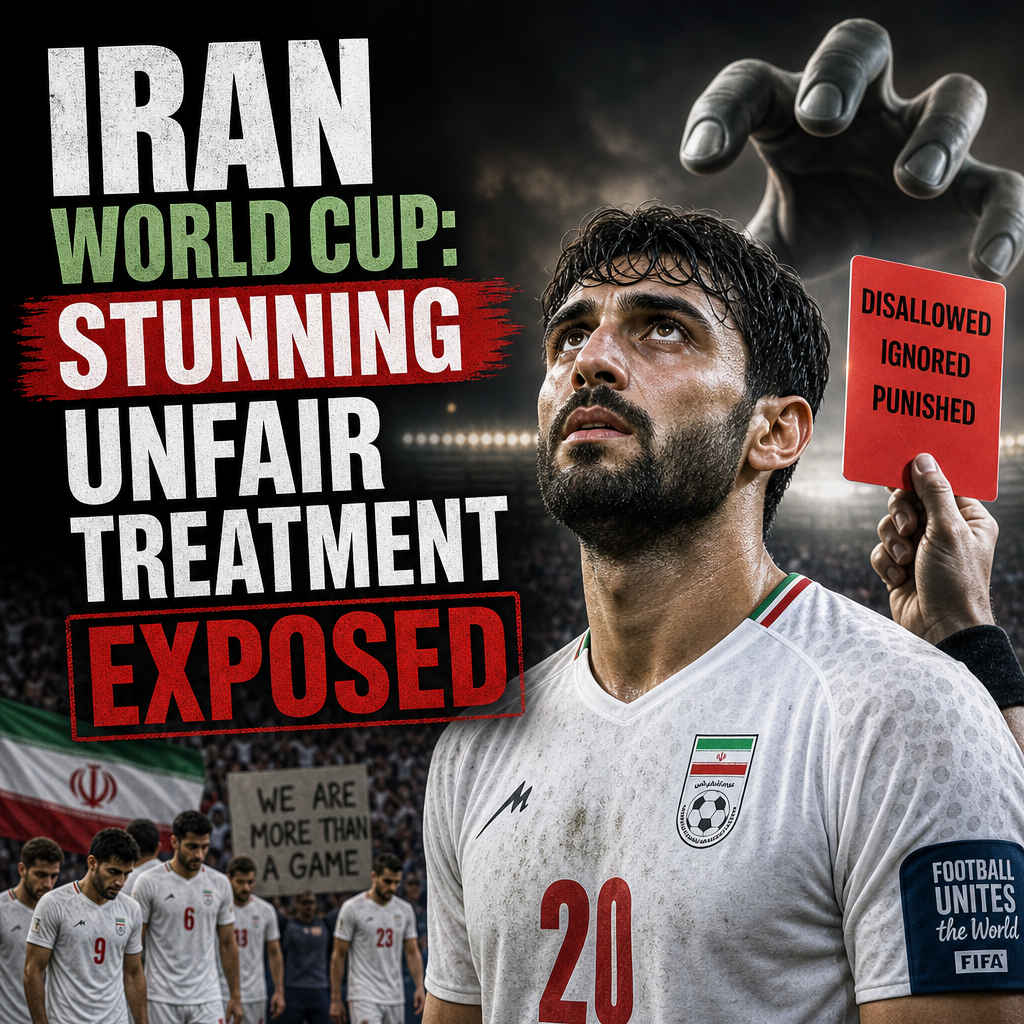
Iran World Cup: Stunning Unfair Treatment Exposed


Iran World Cup coverage has once again brought uncomfortable questions about fairness, politics, and double standards in international football. What emerges from reporting across RT, Al Jazeera, and Sky News is not a simple story of victimhood or conspiracy, but a messier picture: a national team caught between sporting ambition, political pressure at home, and a global football system that often claims neutrality while making deeply political decisions.
Iran World Cup and the politics surrounding the pitch
The most striking theme in the coverage is that Iran’s World Cup experience cannot be separated from politics. RT’s reporting has leaned heavily into the argument that Iran has been treated unfairly by powerful institutions and media narratives, framing the issue as part of a broader pattern in which the country is singled out. That perspective resonates with audiences who see Western sports bodies as inconsistent, especially when sanctions, diplomacy, and international tensions spill into football.



Al Jazeera’s coverage, by contrast, tends to place the football story inside a wider regional and social context. Rather than presenting the issue purely as a clash between Iran and outside actors, it often emphasizes the pressures surrounding the team itself: the expectations of fans, the symbolism of national representation, and the fact that players can become public figures in political debates whether they want that role or not. This lens is important because it highlights a reality that can be missed in more confrontational reporting: the unfair treatment is not always visible in one dramatic incident. Sometimes it accumulates through unequal scrutiny, restricted movement, or the burden of being turned into a political symbol.
Sky News’ style of reporting, meanwhile, typically focuses on the human and institutional side of the story. That includes how football authorities, host nations, and broadcasters handle controversy, but also how players and supporters experience it. The British outlet’s angle is usually less accusatory than RT’s and less regionally contextual than Al Jazeera’s, but it still underscores a key point: when a team enters a major tournament under geopolitical strain, the game is never just a game.




What counts as unfair treatment?
The phrase “unfair treatment” can mean several different things in the World Cup context:
– unequal media coverage and framing
– heightened political pressure on players
– restrictions or complications for supporters
– inconsistent enforcement of football regulations
– perceptions that some nations receive more lenient treatment than others
These complaints are not all equally proven in every case, which is why it is worth being careful. Some accusations are rooted in real administrative problems; others are shaped by national sentiment or online amplification. Still, the fact that the issue keeps resurfacing suggests that football’s governing structure has a credibility problem. FIFA and related bodies often insist that sport should remain separate from politics, yet tournaments repeatedly expose how impossible that separation is in practice.
The players are often stuck in the middle
One of the most compelling aspects of the Iran story is that the players themselves are rarely in control of the narrative. They may be expected to stand for national pride, speak for millions, and answer for government actions, even though their job is to compete on the field. That tension is especially sharp when their public gestures, silence, or celebrations are interpreted as political statements.
This is where the different source perspectives matter. Al Jazeera’s reporting tends to give more weight to the social and emotional pressures on athletes and supporters. RT emphasizes the idea that external critics are quick to moralize while ignoring their own biases. Sky News often highlights the wider audience reaction and the institutional response, which can reveal how controversies are managed rather than solved.
Taken together, those viewpoints suggest an uncomfortable truth: in modern football, neutrality is often an illusion. Teams from politically sensitive countries are not judged only by results. They are judged by symbolism, by headlines, and by the assumptions observers bring with them.
Why the story matters beyond one tournament
It would be easy to dismiss this as just another World Cup controversy, but that would miss the larger lesson. Iran’s experience reflects a broader pattern in global sport, where some nations are afforded the luxury of being seen as “just football teams,” while others are read through a geopolitical lens no matter what they do. That imbalance feeds resentment and makes trust in international institutions harder to sustain.
The most responsible conclusion is not that every allegation of unfair treatment is automatically true, nor that criticisms are all politically motivated. Rather, the evidence points to a mixed reality:
– there are genuine inequalities in how football’s power structures operate;
– political tensions can distort how teams are treated and portrayed;
– media outlets often emphasize different parts of the story depending on their audience and editorial stance;
– and fans are left to navigate a contest that is as much about identity and power as it is about sport.
That complexity is exactly why the issue deserves careful reporting. The strongest journalism here does not simply shout that a scandal has been exposed. It shows how competing interests, selective outrage, and institutional weaknesses create conditions where unfairness can thrive even when no single decision tells the whole story.
A fair reading of the evidence
If there is a balanced takeaway, it is this: the Iran World Cup debate exposes real tensions, but it also shows how quickly those tensions can be exaggerated into absolute claims. RT pushes the strongest case for bias, Al Jazeera broadens the lens to include political and social context, and Sky News helps anchor the story in how institutions and audiences react. None of these viewpoints alone is complete.
What stands out most is not a single dramatic injustice, but a pattern of vulnerability. Iran’s World Cup presence becomes a test of whether football can genuinely rise above politics. So far, the answer appears to be no. The sport may still offer moments of unity and pride, but the structures around it remain uneven, and some teams are clearly required to carry more than a ball onto the field.